Frequently Asked Questions
The most-asked questions about mathematics and cryptography.
What is cryptography and how does it relate to mathematics?
Cryptography is the discipline of designing and analyzing protocols that keep communications private and secure, and it leans heavily on mathematical structures such as number theory, group theory, and probability. At its core, it turns hard mathematical problems into practical tools for encryption and authentication.
Who are the most influential figures in the history of cryptography?
Names like Auguste Kerckhoffs, Claude Shannon, and Whitfield Diffie stand out for shaping modern cryptographic thinking, while Leonhard Euler and Carl Friedrich Gauss laid the number-theoretic groundwork centuries earlier. More recently, the creators of RSA (Rivest, Shamir, Adleman) and the pioneers of elliptic-curve cryptography are household names in the field.
Where should a complete beginner start learning?
A solid path is to first build comfort with basic number theory and modular arithmetic, then move into symmetric ciphers before tackling public-key systems. Many fans recommend a gentle discrete-mathematics textbook before diving into a dedicated cryptography text.
What are the main branches of mathematics most relevant to cryptography?
Number theory, abstract algebra (especially finite fields and elliptic curves), probability theory, and computational complexity are the four pillars that support most cryptographic constructions. Lattice theory and coding theory have also become increasingly central in recent decades.
What is the difference between symmetric and asymmetric cryptography?
Symmetric cryptography uses a single shared secret key for both encryption and decryption, while asymmetric (public-key) cryptography uses a mathematically linked key pair where one key encrypts and the other decrypts. The latter solves the key-distribution problem that plagues the former.
What are some of the most celebrated breakthroughs in the field?
The 1976 publication of Diffie-Hellman key exchange and the 1977 RSA algorithm are often cited as the moments cryptography became a public, mathematical discipline rather than a government secret. The 1990s introduction of elliptic-curve cryptography and the 2010s rise of lattice-based post-quantum schemes are other landmark shifts.
What is a common misconception about 'unbreakable' encryption?
No widely used cipher has ever been proven mathematically unbreakable; security rests on the assumed hardness of an underlying problem plus adequate key length and correct implementation. 'Unbreakable' in practice means the best known attack costs more resources than the information is worth, not that no attack exists in principle.
How did the Enigma machine and its breaking fit into the bigger story?
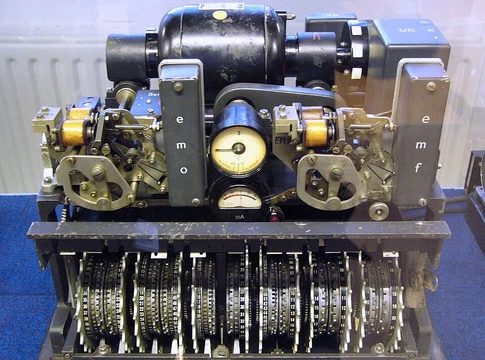
Enigma was a rotor-based symmetric cipher used by the German military in World War II, and its breaking at Bletchley Park by Alan Turing and colleagues showed that even complex mechanical encryption could fall to systematic mathematical and computational analysis. It remains one of the most famous real-world examples of cryptanalysis in action.
What does 'post-quantum cryptography' mean and why is it a hot topic?
Post-quantum cryptography refers to algorithms designed to resist attacks from quantum computers, which could efficiently break the number-theoretic problems underpinning RSA and elliptic-curve schemes. Standards bodies like NIST have been finalizing the first post-quantum standards, making it one of the most active research areas right now.
What are some key facts or trivia fans love to share?
The word 'cryptography' comes from the Greek kryptos (hidden) and graphein (to write), and the field's oldest known example is the 19th-century BCE Scramble Tablet. Fun fact: the Vigenère cipher, long attributed to Blaise de Vigenère, was actually invented by Giovan Battista Bellaso over a century earlier.